من اهل الدار
الياسري
تاريخ التسجيل: September-2013
الدولة: العراق العظيم
الجنس: ذكر
المشاركات: 12,139 المواضيع: 1,594
صوتيات:
45
سوالف عراقية:
0
مزاجي: برتقالي
المهنة: مدرس
أكلتي المفضلة: دولمة
موبايلي: Samsung A55
آخر نشاط: منذ 6 ساعات
الاتصال:

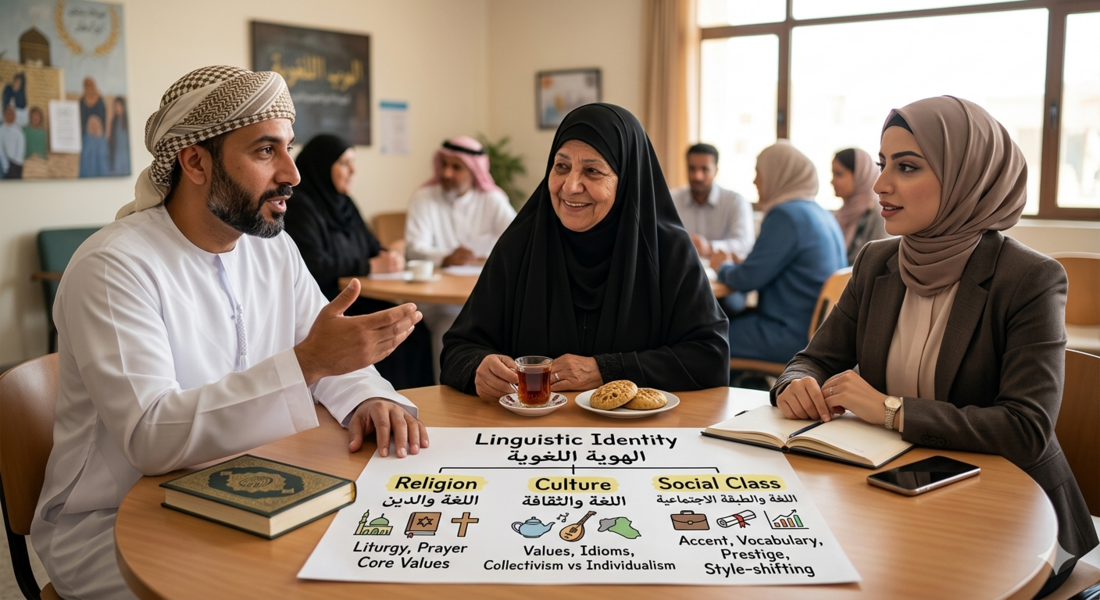
How Language Reflects Personal Identity: Religion, Culture, and Social Class
Introduction
Language is one of the most fundamental markers of human identity. It serves not only as a tool for communication but also as a reflection of personal and social identity. Sociolinguistics, a subfield of linguistics, studies the intricate relationship between language and society, emphasizing how language both shapes and is shaped by social interactions (Bucholtz & Hall, 2004, p. 374). Through language, individuals signal their membership in specific social, cultural, and religious groups, and indicate their social class, level of education, and regional background.
The construction of identity through language is dynamic and multidimensional. It operates on both conscious and unconscious levels: while a speaker may deliberately use certain words to signal group membership, some linguistic markers, such as accent or vocabulary choice, reveal identity features automatically. In this paper, we explore three primary dimensions through which language reflects personal identity: religion, culture, and social class.
1. Language and Religious Identity
Language functions as a powerful medium for expressing religious identity. Religious identity is often communicated through specific lexical choices, recurring expressions, and speech patterns associated with religious practices. Phrases such as “Inshallah” (God willing), “Alhamdulillah” (Praise be to God), or “Peace be upon you” serve not only functional communication purposes but also reinforce the speaker’s spiritual alignment and community membership (Gordon, 2021, p. 42).
Moreover, the use of sacred or classical languages within religious contexts—such as Arabic in Islamic practices, Latin in Catholic rituals, or Sanskrit in Hindu ceremonies—establishes boundaries between religious groups while strengthening intra-group cohesion (Crystal, 2010, p. 189). This demonstrates that language can act as both a marker and a constructor of religious identity.
Religious identity through language is not limited to formulaic expressions. Sermons, prayers, and religious storytelling also convey values, norms, and beliefs, further reinforcing the sense of belonging and the moral worldview of the speaker (Gordon, 2021, p. 45). Even within the same language, regional variations of religious expressions reflect different theological emphases or historical developments.
2. Language and Cultural Identity
Language is inherently tied to culture, as it encodes social norms, traditions, and collective knowledge. Through language, individuals express cultural values, etiquette, and worldview. Sociolinguists argue that culture and language are inseparable, and that cultural identity is performed through linguistic practices (Ogbu, 2004, p. 56). For instance, the way people greet, express politeness, or narrate stories reflects deep-rooted cultural assumptions about hierarchy, respect, and interpersonal relationships.
2.1 Dialects and Cultural Variation
Dialects are a key aspect of cultural identity. Different regions or social groups develop distinct ways of speaking, including unique vocabulary, pronunciation, and syntax. These differences function as markers of belonging and help distinguish “in-group” members from outsiders (Labov, 2006, p. 123). For example, within the English-speaking world, British, American, Australian, and Indian English varieties not only differ in pronunciation but also carry cultural connotations. The choice of dialect or accent can signal alignment with a particular cultural group or identity.
2.2 Multilingualism and Code-Switching
In multilingual societies, speakers frequently switch between languages or dialects depending on context—a phenomenon known as code-switching. Code-switching reflects both cultural hybridity and social identity, allowing speakers to negotiate different cultural spaces simultaneously (Gumperz, 1982, p. 66). For example, Arab-American youth may alternate between Arabic and English depending on whether they are interacting with family or peers, simultaneously signaling cultural belonging to both communities. Code-switching is not random; it is socially and culturally motivated, reflecting speakers’ awareness of linguistic norms and identity expectations.
2.3 Cultural Idioms and Expressions
Idiomatic expressions, proverbs, and culturally-specific phrases are another aspect of linguistic-cultural identity. Phrases such as “break the ice” in English or “kicking the cat” (a figurative expression in some cultures) carry meanings that cannot be directly translated without cultural context (Crystal, 2010, p. 202). By using these idioms appropriately, speakers signal not only language proficiency but also cultural familiarity, embedding themselves within a particular community.
3. Language and Social Class
Social stratification is deeply intertwined with language use. Speakers’ accents, choice of vocabulary, and syntactic structures often reveal their socioeconomic status, education level, and professional background (Bourdieu, 1991, p. 37). Sociolinguistic studies consistently show that language functions as a form of social capital, where certain varieties are considered prestigious and others stigmatized.
3.1 Accent and Prestige
Standard language varieties or “prestige accents” are often associated with higher social status and formal education. For instance, Received Pronunciation (RP) in the UK is linked historically with upper-class identity, whereas regional accents may mark working-class identity (Labov, 2006, p. 145). The perception of prestige influences how speakers are treated in educational, professional, and social contexts, highlighting the role of language as a social differentiator.
3.2 Vocabulary and Professional Identity
Lexical choices and specialized jargon also convey class and occupational identity. Professionals in law, medicine, or business often use domain-specific terminology that signals membership within a particular knowledge community. This demonstrates that language is not merely a communicative tool but also a symbolic resource for signaling competence and status (Bourdieu, 1991, p. 45).
3.3 Linguistic Capital
Pierre Bourdieu introduced the concept of linguistic capital, emphasizing that the mastery of certain language forms can increase social mobility and access to opportunities (Bourdieu, 1991, p. 38). This further underscores that language is both reflective and constitutive of social hierarchies.
4. Dynamic Identity Construction Through Language
Identity is not static; it is continuously negotiated through linguistic interaction. Speakers adapt their language use according to social context, audience, and communicative goals. Bucholtz and Hall (2004, p. 382) argue that identity is “produced and reproduced through linguistic practices”, emphasizing that language both reflects existing social structures and actively constructs identity.
Examples of dynamic identity construction include:
Adjusting accent or vocabulary in formal versus informal settings
Switching between languages to reflect cultural or situational alignment
Using social media language to perform youth, digital, or global identities
In essence, language functions as both a mirror and a tool, simultaneously reflecting personal identity and shaping social reality.
Conclusion
Language is a powerful lens through which personal identity can be understood. Religion, culture, and social class are all reflected in the way individuals speak, the words they choose, and the linguistic patterns they adopt. Sociolinguistics highlights that identity is not only encoded in language but actively performed and negotiated through it. By examining linguistic practices, researchers can gain profound insights into human society, social hierarchy, and cultural affiliation. Understanding these dynamics is crucial in an increasingly interconnected and multilingual world.
References
- Bourdieu, P. (1991). Language and symbolic power. Cambridge, MA: Harvard University Press. pp. 37–45.
- Bucholtz, M., & Hall, K. (2004). Language and identity. Discourse Studies, 6(3), 374–392. https://doi.org/10.1177/1461445604044238
- Crystal, D. (2010). The Cambridge encyclopedia of language (3rd ed.). Cambridge: Cambridge University Press. pp. 189–202.
- Gordon, E. (2021). The role of religious expressions in sociolinguistic identity. Global Journal of Sociolinguistics, 15(2), 42–46. https://www.giirj.com/index.php/giirj/article/view/7077
- Gumperz, J. J. (1982). Discourse strategies. Cambridge: Cambridge University Press. pp. 66–70.
- Labov, W. (2006). The social stratification of English in New York City (2nd ed.). Cambridge: Cambridge University Press. pp. 123–145.
- Ogbu, J. U. (2004). Collective identity and language in multicultural contexts. Journal of Sociolinguistics, 8(1), 56–60. https://ojs.stai-ibnurusyd.ac.id/ind...rticle/view/20






 رد مع اقتباس